Keynote address at the Itinerant Teacher of the Deaf (ITOD) conference in Australia in October 2023.
In her ITOD conference keynote, Dr Fiona Kyle discussed pre-implant predictors of post-implant language for deaf children with cochlear implants, and presented new data on the efficacy of the Grammar and Phonology Screening Test (GAPS) in identifying spoken language difficulties in DHH children. The abstract for the talk is below.
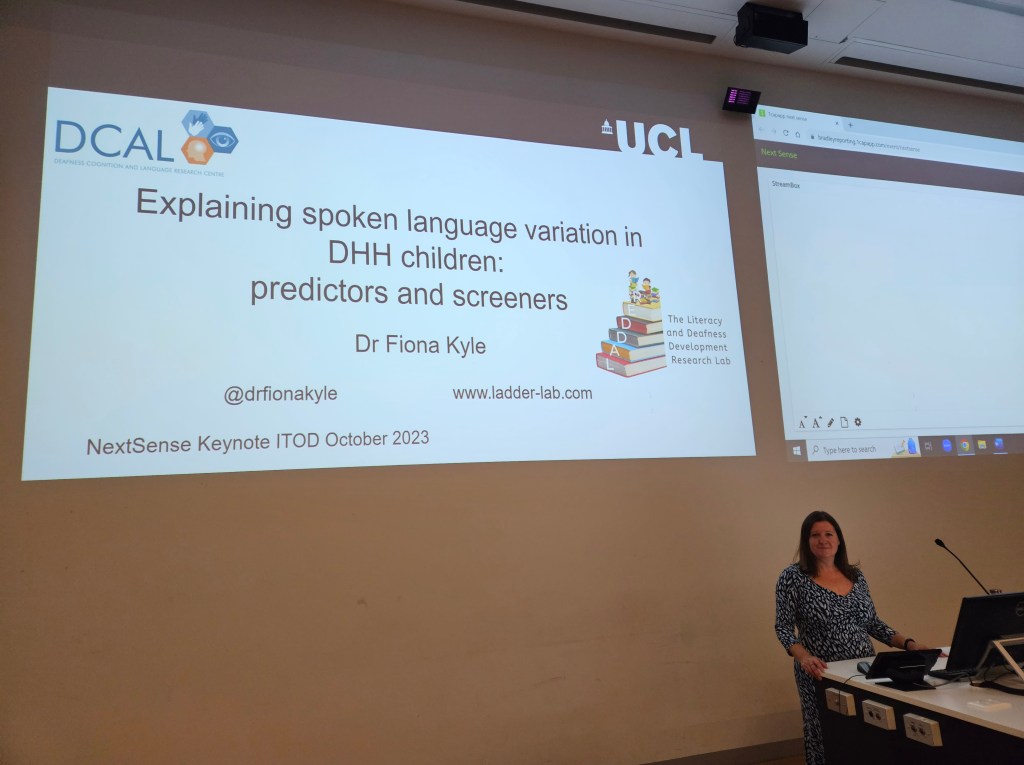
Abstract for ITOD 2023 – Explaining spoken language variation in DHH children – predictors and screeners
Despite advances in hearing aid technology and cochlear implants, there is still considerable variation in spoken language outcomes for deaf and hard of hearing children (DHH). To support DHH children to achieve good spoken language outcomes, we need to (1) understand more about the underlying causes of this variation, and (2) identity early those DHH children who may develop language difficulties. I will present data from two recent studies in which we attempt to address these issues. I will begin by discussing the results of our recent study investigating pre-implant predictors of post-implant language in a group of DHH with cochlear implants. Using a retrospective case analysis design, we found that pre-implant social communication skills were associated with post-implant spoken language outcomes four years later. I will then present data from on ongoing study examining the efficacy of the Grammar and Phonology Screening Test (GAPS) to identify spoken language difficulties in DHH children. The GAPS was designed to be administered by teachers and other practitioners with hearing children. Our results suggest it has high sensitivity and specificity as a screener of grammatical difficulties in preschool DHH children. Results from both of these studies will be discussed within a wider framework arguing for the importance of early language support and intervention for DHH children.
_______________________________________________________________
Spoken paper presented at the Society for the Scientific Studies of Reading (SSSR) conference in Newport Beach, California, USA in July 2022
Abstract for SSSR 2022 – Relationship between preschool spoken language skills and reading in deaf and hearing children (Kyle, Mason, Beedie & Herman)
Purpose: Vocabulary and phonological skills are consistent predictors of reading outcomes in school-age deaf children who use spoken language. Less is known about the predictive role of preschool phonological and grammatical skills for their later reading ability. In this paper, we present data from a two-year longitudinal study investigating the development of emergent literacy, language and phonological skills in preschool deaf children using spoken language.
Methods: 102 preschool children (51 deaf and 51 hearing) participated in the study. All children were aged between 3 and 4 year olds when recruited into the study and assessed again two years later. Children were assessed on a broad range of preschool language skills including grammatical (sentence repetition, word structure and sentence structure), phonological (nonword repetition, phonological awareness and speechreading), vocabulary knowledge and letter-sound knowledge.
Results: Deaf children showed an uneven pattern of performance across the different preschool spoken language tasks. As a group, they exhibited grammatical and phonological delays but they had age-appropriate expressive vocabulary and letter-sound knowledge. As expected, hearing children made more progress than deaf children in spoken grammatical and phonological skills, and letter sound knowledge over the two-year period. There were similarities and differences between the two groups in the relationships between preschool language and later word reading outcomes.
Conclusion: Although many preschool deaf children had age-appropriate vocabulary and letter-sound knowledge, their weaker phonological and broader language skills increased the risk of exhibiting later word reading delays.
_________________________________________________________________
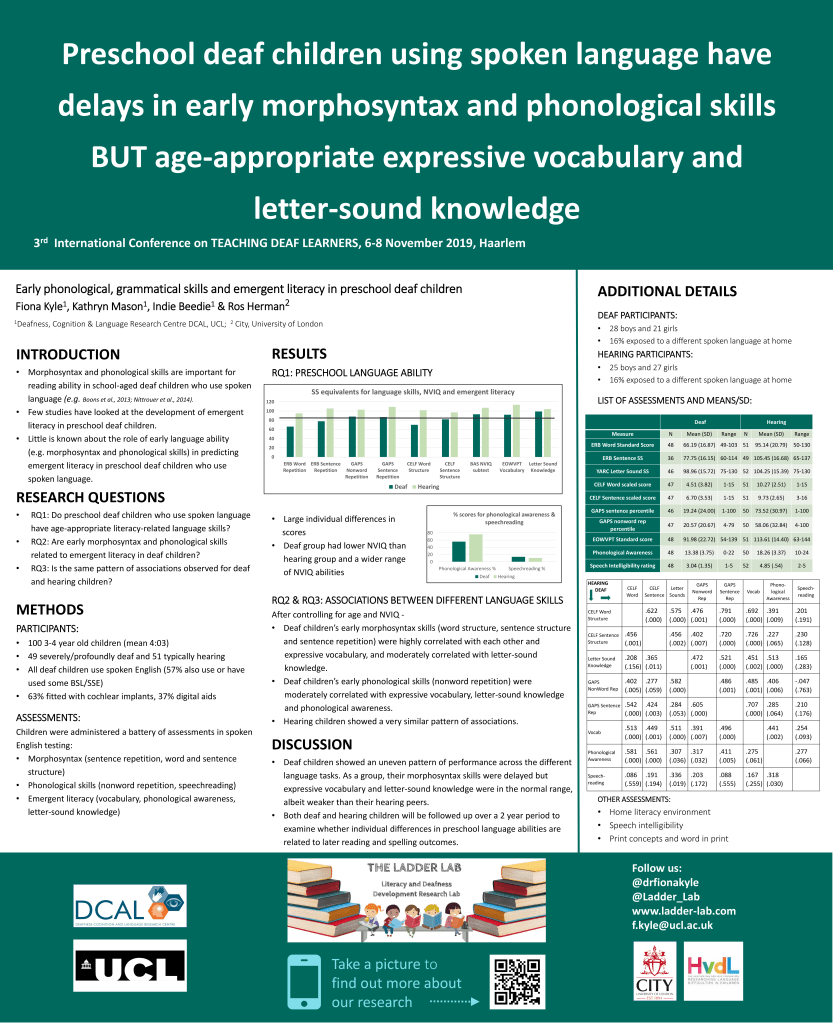
Poster from 3rd International Conference on TEACHING DEAF LEARNERS, 6-8 November 2019, Haarlem
 The Ladder Lab