Spoken paper presented at the Society for the Scientific Studies of Reading (SSSR) 2026 conference in Rotterdam in July 2026
Abstract for SSSR 2026 – Morphological Awareness and Reading Comprehension in Deaf and Hearing Children (Fiona Kyle, Katie Swift, Kathryn Mason, Amy Hegedus, Jan Frijters & Ros Herman)
Purpose: This cross-sectional study investigates the role of morphology in reading comprehension for deaf and hearing children in middle childhood. Reading outcomes remain highly variable for deaf children, despite overall levels showing recent improvements. Past research has focused on the role of phonological skills and vocabulary knowledge in predicting their reading outcomes. Less is known about the possible contribution of written morphology to deaf children’s reading comprehension.
Methods: Participants were 349 children ages 8-9 years old. There were 132 deaf and 217 hearing children. It was an inclusive sample consisting of children with lower NVIQ, additional difficulties, or those exposed to another language at home. Deaf children varied in their language preferences including spoken English, BSL, or English/BSL bilingual-bimodal. Children completed a large battery of tasks measuring reading comprehension, phonological awareness, vocabulary (breadth and depth), and morphological awareness (inflections and derivations).
Results: At the group level, deaf children had lower scores across all the tasks. However, there was considerable heterogeneity and some deaf children had very high levels of reading ability. Broadly similar patterns of associations were found for deaf and hearing children: morphological awareness was significantly correlated with phonological awareness, vocabulary, and reading comprehension. Mediation analyses revealed that morphological awareness had a significant direct path to reading comprehension and a significant indirect path via vocabulary. Regression analyses showed that morphological awareness predicted reading comprehension after controlling for NVIQ, phonological awareness and vocabulary.
Conclusion: Morphological awareness contributes to deaf children’s reading comprehension, but longitudinal studies are needed to determine whether the relationship is bidirectional.
Spoken paper presented at the Child Language Symposium 2026 conference in London in July 2026
Abstract for CLS 2026 – The contribution of the preschool home literacy environment to deaf children’s language and literacy skills (Kathryn Mason, Indie Beedie, Ros Herman, & Fiona Kyle)
Background: The home literacy environment (HLE) is an important predictor of children’s early language and literacy skills. Language and literacy outcomes are improving but remain variable for deaf children. This longitudinal study aimed to determine the relationship between preschool HLE and child language and literacy outcomes after their first year of school in hearing and deaf children who use spoken language.
Methods: Participants were 69 deaf and 59 hearing children aged 4-5 years. Their parents completed a questionnaire about the preschool HLE, including questions about literacy behaviours around shared storybook-reading (SBR), (e.g. how often they read to their child and discuss the content of books), and child literacy behaviours, such as their child’s engagement during SBR, and interest in letters. A year later, at the end of their first year of school, children completed tasks assessing their emergent language and literacy skills, including phonological awareness (PA), letter-sound knowledge, vocabulary, early reading and spelling ability.
Results: Deaf and hearing children differed in their parent-reported preschool HLE, and in the relationship between the HLE and later language and literacy outcomes. For deaf children, all HLE components were related to later PA and vocabulary, and child literacy interest was related to literacy outcomes. For hearing children, only child interest was related to reading outcomes.
Conclusion: Children who show a greater interest in literacy activities in preschool have higher language and literacy skills at the end of their first year of school. Preschool HLE exerted a greater influence on later outcomes in deaf compared with hearing children. All HLE-practices predicted greater PA and vocabulary skills a year later in deaf children; skills known to be particularly important in reading development. This is the first study to look at the longitudinal contribution of preschool HLE to language and literacy outcomes, including early reading and spelling, in a diverse sample of deaf children at the end of their first year of mainstream UK education.
Spoken paper presented at the Society for the Scientific Studies of Reading (SSSR) 2025 conference in Calgary, Canada in July 2025
Abstract for SSSR 2025 – The role of executive functions and language skills in deaf children’s reading ability in middle childhood (Fiona Kyle, Sharon Ting, Kathryn Mason, Amy Hegedus, Jan Frijters & Ros Herman)
Purpose: Reading outcomes are highly variable for deaf children. Most research with deaf children has focused on the role of phonological skills and vocabulary knowledge in predicting their reading outcomes. Less is known about the possible contribution of broader aspects of language and executive functions (EF). This talk will present data from the first year of a new longitudinal study investigating the development of word reading, reading comprehension, language and EF in deaf and hearing children in middle childhood.
Methods: Participants were 105 severely/profoundly deaf and 180 hearing children, aged between 8 and 9 years old. Deaf children varied in their language preferences including spoken English, BSL, or English/BSL bilingual-bimodal. The sample was representative because deaf children were from all over England and included those with low NVIQ, additional difficulties, or exposed to another language at home. Children completed a large battery of tasks measuring different components of reading, EF, and language (English and BSL).
Results: Deaf children showed an uneven pattern of performance across the different standardised reading, language and EF tests with large within-group variation. As a group, they had weaker reading skills compared to their age-matched hearing peers, yet some deaf children had very high levels of reading ability. Preliminary models revealed broadly similar patterns of relationships between reading, language and EF for deaf and hearing children, but with some important differences depending upon which language and reading component was assessed.
Conclusion: The findings suggest that EF can contribute to deaf children’s reading skills alongside the fundamental role of language ability.
Poster presented at the International Congress for the Education of Deaf Children (ICED) 2025 conference in Rome, Italy in July 2025
Abstract for ICED 2025 – Deaf children’s Home Literacy Environments (HLE), interest in reading, and their preschool vocabulary, grammar and emergent literacy skills (Fiona Kyle, Kathryn Mason, Marco Cangini & Ros Herman)
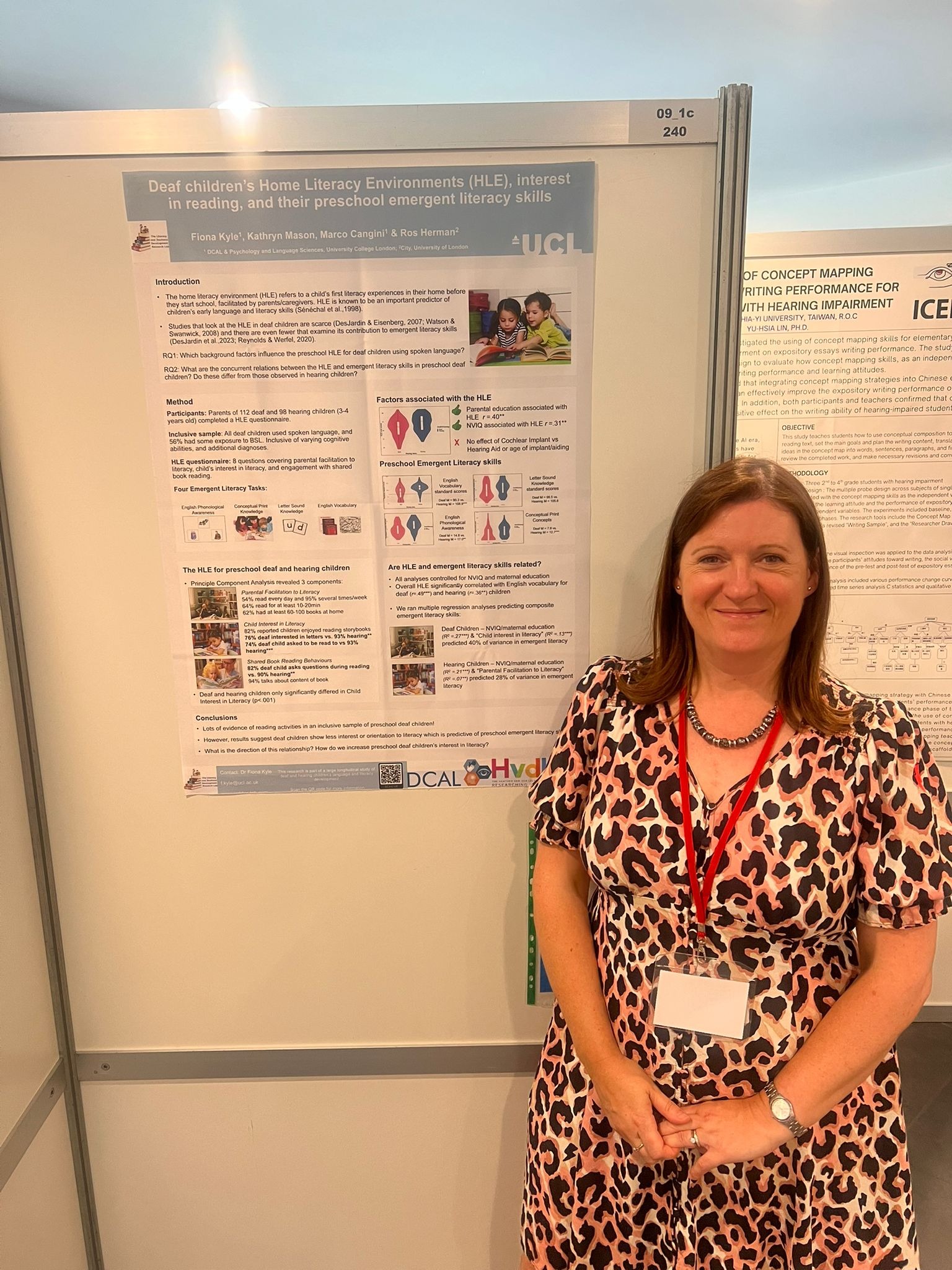
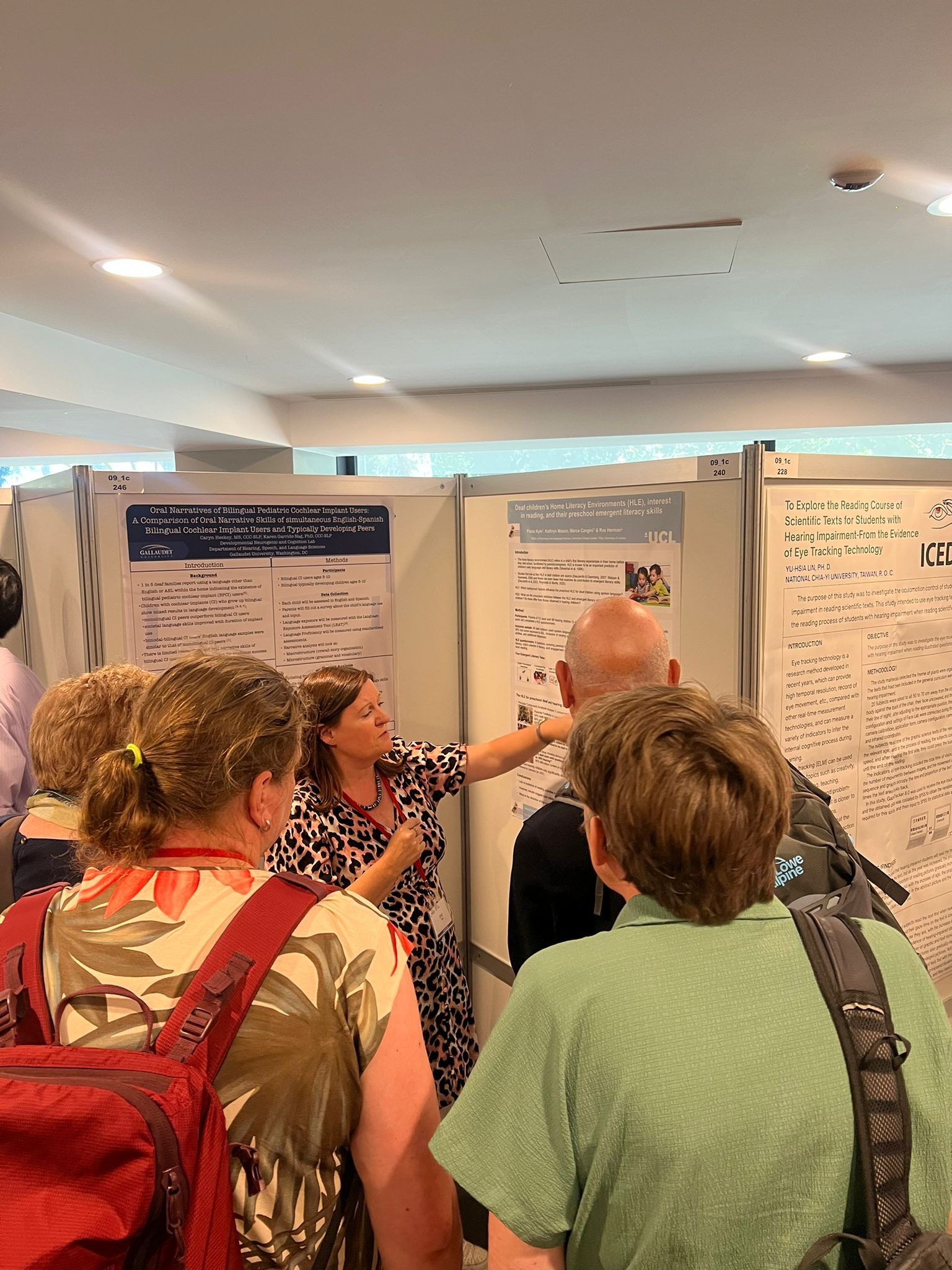
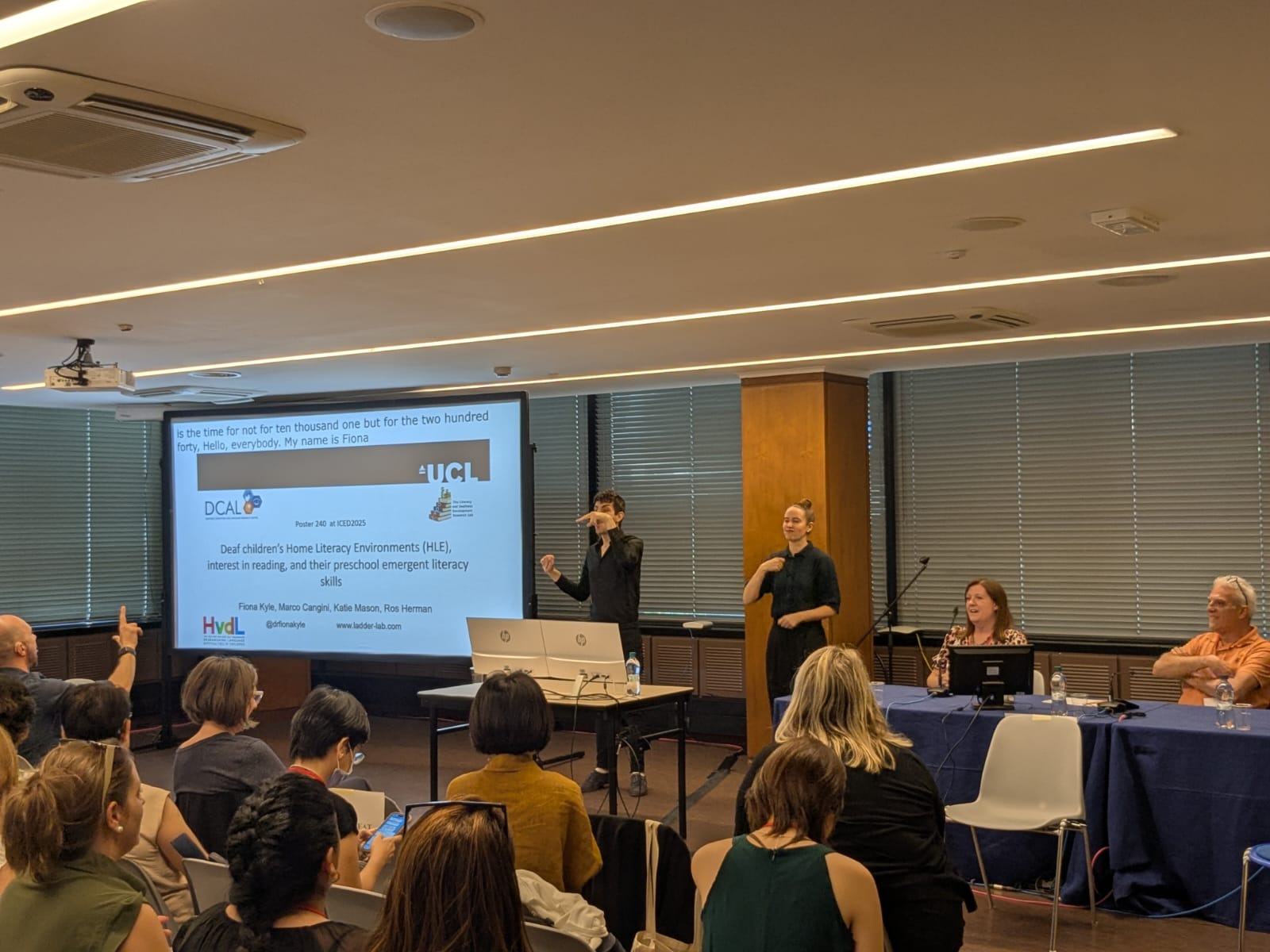
Background: In this talk, we present parent-reported data on the preschool home literacy environments (HLE) for a large, representative and inclusive sample of deaf children using spoken language. The HLE refers to the literacy-related resources and activities undertaken in the home such as how many books are in the home and how often children are read to. The HLE plays an important role in preschool children’s emergent literacy and early reading acquisition, yet relatively few studies have examined this in deaf children. We investigate the relationship between the preschool HLE, child’s interest in literacy, spoken language skills, and emergent literacy skills in deaf and hearing children.
Methods: 210 preschool children (112 deaf and 98 hearing) participated in this study. All children were between 3 and 4 years old. The study is representative as children were not excluded based upon having low NVIQ, additional difficulties, or being exposed to another spoken language at home. All deaf children were using spoken language but 57% of them also had exposure to varying levels of BSL. Parents completed a HLE questionnaire reporting on the frequency of book reading, child interest in reading, and shared book reading behaviours. Children were assessed on a large battery of tasks measuring vocabulary, grammar and emergent literacy skills.
Results: Deaf children showed an uneven pattern of performance across the emergent literacy tasks. Analyses revealed three preschool HLE components: (1) parental facilitation of literacy; (2) child interest in reading; and (3) shared book reading behaviours. The groups did not differ in overall facilitation of literacy or shared book reading behaviours, but parents of hearing children reported higher levels of child interest in reading. For deaf children, interest in reading was important for emergent literacy whereas facilitation of literacy was most important for hearing children’s emergent literacy.
Conclusion: There was lots of evidence of reading activities in the home for preschool deaf children. Although there were few differences between deaf and hearing children in parental facilitation to literacy in preschool, providing a HLE for deaf children that exposes them to literacy materials and allows them to explore their interests is important for their emergent literacy.
Spoken paper presented at the International Congress for the Education of Deaf Children (ICED) 2025 conference in Rome, Italy in July 2025
Abstract for ICED 2025 – The Contribution of the Preschool Home Literacy Environment to Deaf children’s Language and Literacy Skills after One-Year of Formal Schooling (Kathryn Mason, Katharine O’Neill, Ros Herman & Fiona Kyle)
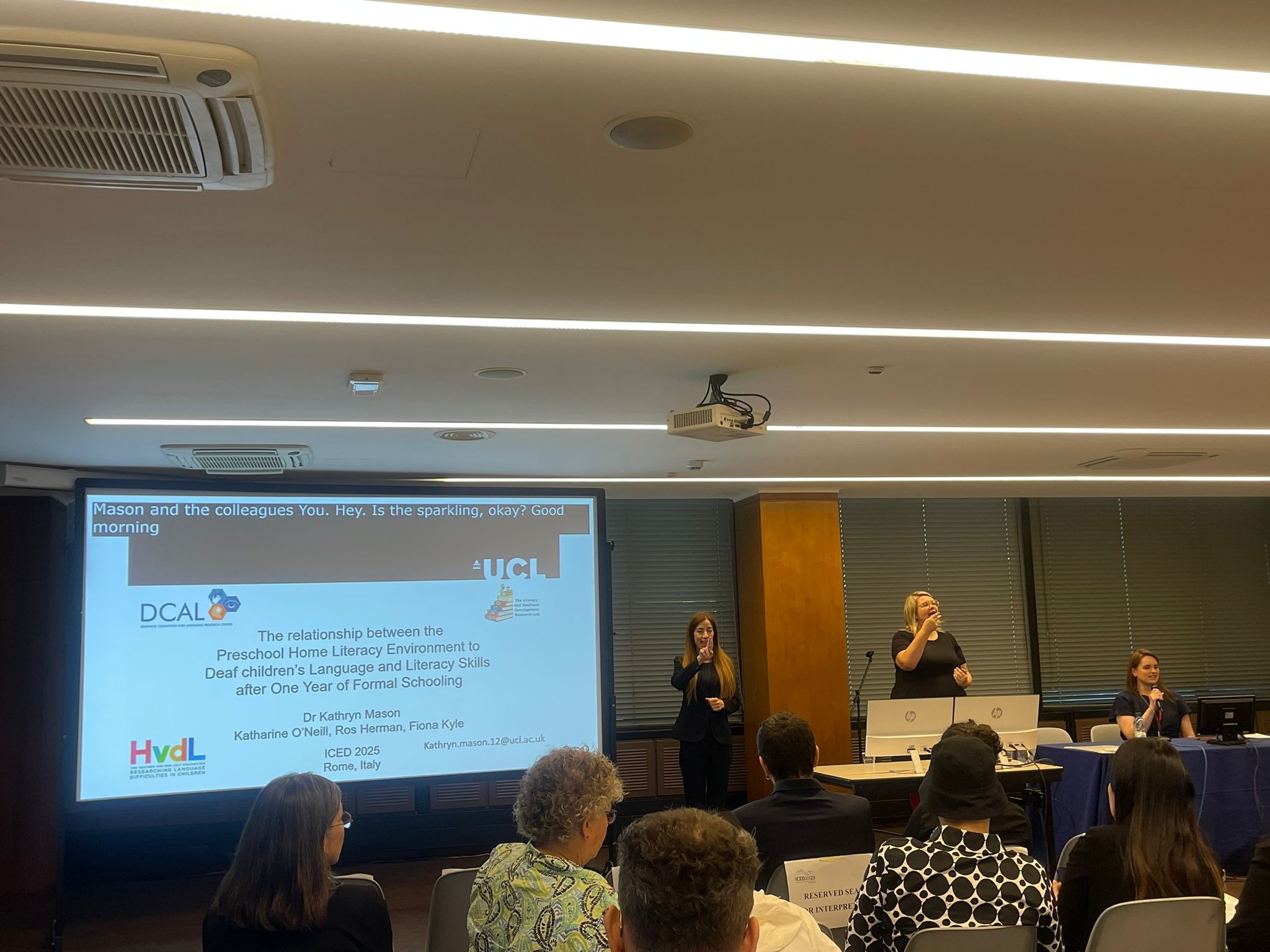
Purpose: The home literacy environment (HLE) is an important predictor of children’s early language and literacy skills. Language and literacy outcomes are improving but remain variable for deaf children. This longitudinal study aimed to determine the relationship between preschool HLE and child language and literacy outcomes after their first year of school in hearing and deaf children who use spoken language.
Methods: Participants were 69 deaf and 59 hearing children aged 4-5 years. Their parents completed a questionnaire about the preschool HLE, including questions about literacy behaviours around shared storybook-reading (SBR), (e.g. how often they read to their child and discuss the content of books), and child literacy behaviours, such as their child’s engagement during SBR, and interest in letters. A year later, at the end of their first year of school, children completed tasks assessing their emergent language and literacy skills, including phonological awareness (PA), letter-sound knowledge, vocabulary, early reading and spelling ability.
Results: Deaf and hearing children differed in their parent-reported preschool HLE, and in the relationship between the HLE and later language and literacy outcomes. For deaf children, all HLE components were related to later PA and vocabulary, and child literacy interest was related to literacy outcomes. For hearing children, only child interest was related to reading outcomes.
Conclusion: Children who show a greater interest in literacy activities in preschool have higher language and literacy skills at the end of their first year of school. Preschool HLE exerted a greater influence on later outcomes in deaf compared with hearing children. All HLE-practices predicted greater PA and vocabulary skills a year later in deaf children; skills known to be particularly important in reading development. This is the first study to look at the longitudinal contribution of preschool HLE to language and literacy outcomes, including early reading and spelling, in a diverse sample of deaf children at the end of their first year of mainstream UK education.
Spoken paper presented at the Society for the Scientific Studies of Reading (SSSR) 2024 conference in Copenhagen, Denmark in July 2024
Abstract for SSSR 2024 – Home Literacy Environment and Emergent Literacy Skills in Preschool Deaf and Hearing Children (Fiona Kyle, Kathryn Mason, Marco Cangini & Ros Herman)
Purpose: Emergent literacy skills vary widely for deaf children who use spoken language. The Home Literacy Environment (HLE) plays an important role in preschool children’s emergent literacy and early reading acquisition, yet relatively few studies have examined this in deaf children. In this paper, we present data investigating the relationship between the preschool HLE, child’s interest in literacy, and emergent literacy skills in deaf and hearing children.
Methods: 213 preschool children (103 deaf and 110 hearing) participated. All children were aged between 3 and 4 year olds. Parents completed a HLE questionnaire reporting on the frequency of book reading, child interest in reading, and shared book reading behaviours. Children were assessed on a large battery of tasks measuring language and emergent literacy skills.
Results: Deaf children showed an uneven pattern of performance across the emergent literacy tasks. Analyses revealed two preschool HLE components: (1) facilitation and interest in literacy; and (2) shared book reading behaviours. The groups did not differ in facilitation and interest in literacy but parents of hearing children reported higher engagement in shared book reading. For deaf children, facilitation and interest in literacy was important for emergent literacy whereas shared book reading behaviours was most important for hearing children’s emergent literacy.
Conclusion: Although there were few differences between deaf and hearing children in parental access to literacy in preschool, providing a HLE for deaf children that exposes them to literacy materials and allows them to explore their interests is important for their emergent literacy.
Keynote address at the Itinerant Teacher of the Deaf (ITOD) conference in Australia in October 2023.
In her ITOD conference keynote, Dr Fiona Kyle discussed pre-implant predictors of post-implant language for deaf children with cochlear implants, and presented new data on the efficacy of the Grammar and Phonology Screening Test (GAPS) in identifying spoken language difficulties in DHH children. The abstract for the talk is below.
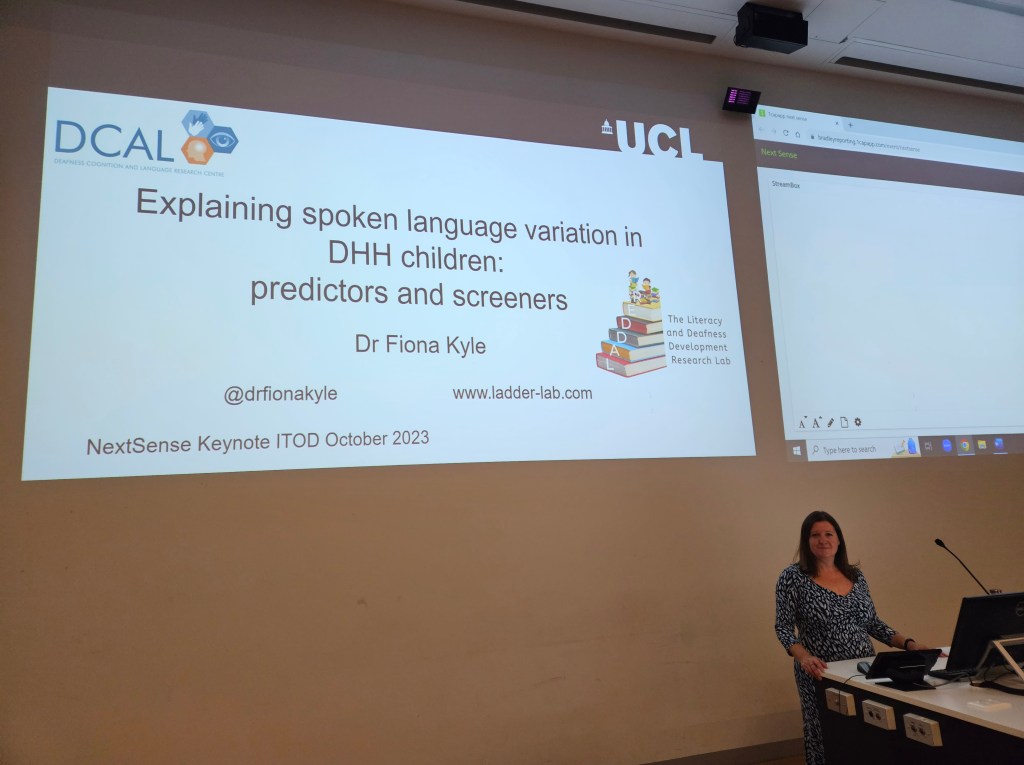
Abstract for ITOD 2023 – Explaining spoken language variation in DHH children – predictors and screeners
Despite advances in hearing aid technology and cochlear implants, there is still considerable variation in spoken language outcomes for deaf and hard of hearing children (DHH). To support DHH children to achieve good spoken language outcomes, we need to (1) understand more about the underlying causes of this variation, and (2) identity early those DHH children who may develop language difficulties. I will present data from two recent studies in which we attempt to address these issues. I will begin by discussing the results of our recent study investigating pre-implant predictors of post-implant language in a group of DHH with cochlear implants. Using a retrospective case analysis design, we found that pre-implant social communication skills were associated with post-implant spoken language outcomes four years later. I will then present data from on ongoing study examining the efficacy of the Grammar and Phonology Screening Test (GAPS) to identify spoken language difficulties in DHH children. The GAPS was designed to be administered by teachers and other practitioners with hearing children. Our results suggest it has high sensitivity and specificity as a screener of grammatical difficulties in preschool DHH children. Results from both of these studies will be discussed within a wider framework arguing for the importance of early language support and intervention for DHH children.
_______________________________________________________________
Spoken paper presented at the Society for the Scientific Studies of Reading (SSSR) conference in Newport Beach, California, USA in July 2022
Abstract for SSSR 2022 – Relationship between preschool spoken language skills and reading in deaf and hearing children (Kyle, Mason, Beedie & Herman)
Purpose: Vocabulary and phonological skills are consistent predictors of reading outcomes in school-age deaf children who use spoken language. Less is known about the predictive role of preschool phonological and grammatical skills for their later reading ability. In this paper, we present data from a two-year longitudinal study investigating the development of emergent literacy, language and phonological skills in preschool deaf children using spoken language.
Methods: 102 preschool children (51 deaf and 51 hearing) participated in the study. All children were aged between 3 and 4 year olds when recruited into the study and assessed again two years later. Children were assessed on a broad range of preschool language skills including grammatical (sentence repetition, word structure and sentence structure), phonological (nonword repetition, phonological awareness and speechreading), vocabulary knowledge and letter-sound knowledge.
Results: Deaf children showed an uneven pattern of performance across the different preschool spoken language tasks. As a group, they exhibited grammatical and phonological delays but they had age-appropriate expressive vocabulary and letter-sound knowledge. As expected, hearing children made more progress than deaf children in spoken grammatical and phonological skills, and letter sound knowledge over the two-year period. There were similarities and differences between the two groups in the relationships between preschool language and later word reading outcomes.
Conclusion: Although many preschool deaf children had age-appropriate vocabulary and letter-sound knowledge, their weaker phonological and broader language skills increased the risk of exhibiting later word reading delays.
_________________________________________________________________
Poster from 3rd International Conference on TEACHING DEAF LEARNERS, 6-8 November 2019, Haarlem